
Your cart is currently empty!
3 Book Review: The Final Wars Trilogy by SA Asthana

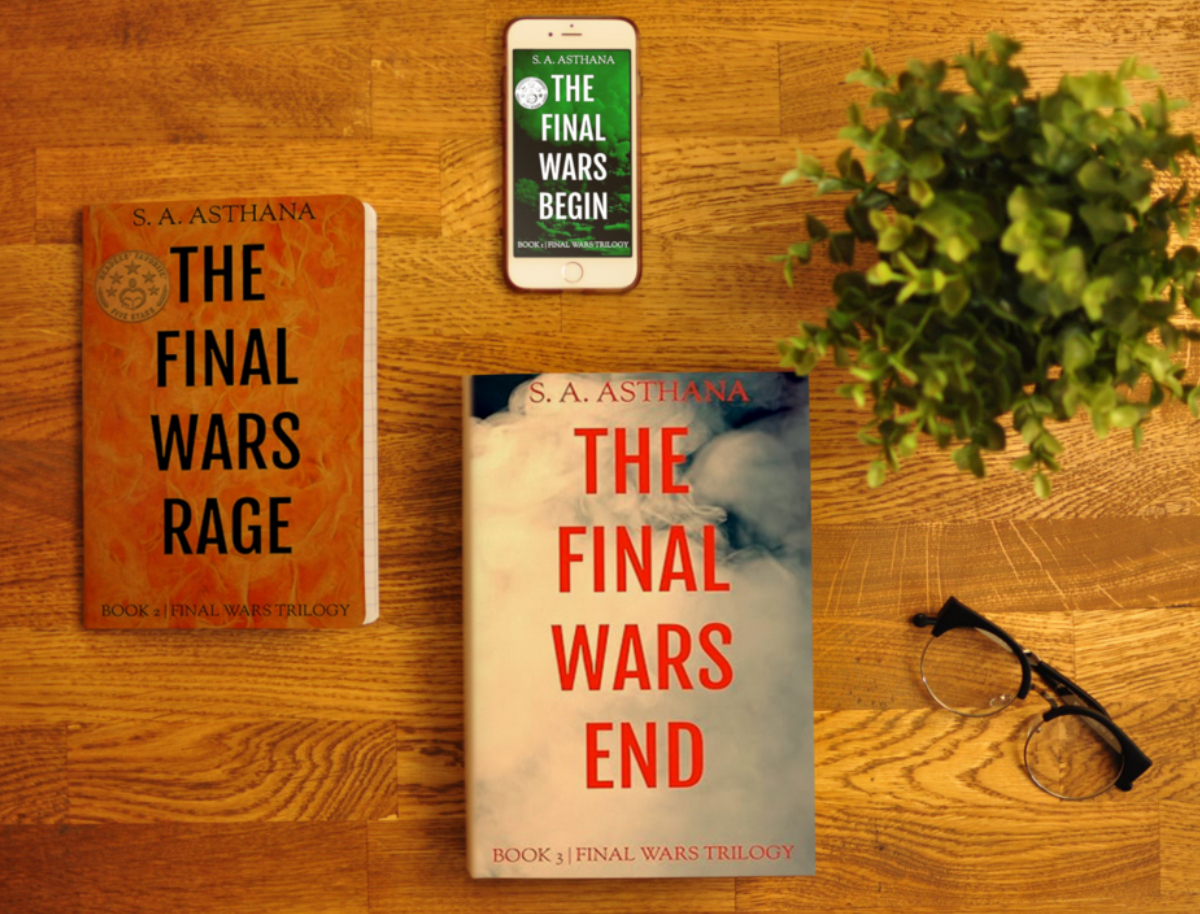

The Final Wars Begin
Earth is a barren husk. Humanity clings precariously to life in three separate colonies; under Paris, on earth, on Mars, and on the moon. When the Trilateral Treaty between the planets is broken, the delicate peace is shattered. Is this how the final wars begin?
In the distant future, World War III has left Earth’s surface uninhabitable, and the remnants of humanity clinging to life in three diverse settlements. New Paris; a squalid mess surviving in the sewers underneath the merciless desert of former France, ruled by a psychotic goddess queen. Port Sydney; a technological marvel on Mars, governed by a quantum computer. Nippon One; a vast civilization on the moon, led by an emperor.
Bastien Lyons, former New Paris sewer brat, once Martian military marvel and now wanted fugitive, never expected his life to come to this. Despite the good teaching of Father Paul, a kindly priest who rescued him as a child, Bastien is afraid that he has dealt with monsters so long that he has become one.
Despite his best intentions, could Bastien be the instigator of humanity’s ultimate demise?
While much of this book concerns Bastien, the scope is much broader than one man’s struggle. Mainly set on Earth, the reader is privy to the machinations of the rulers of all three colonies, allowing us to see the precarious chess game that the last humans play, always one move away from annihilation.
The author skillfully weaves a tale that is sweeping in world building, uncompromising in its societal structure and plot, yet is also compassionate to its characters. Despite being pawns to a larger story, it is impossible not to be drawn into the plight of Bastien and the other New Parisians, developing an emotional connection that makes the inevitable disaster all the more heartbreaking.
I thoroughly enjoyed this book. The extensive world building was never confusing or exposition heavy. The future developments of the human race were plausible. Marie Dubois, self proclaimed goddess queen of New Paris, is depraved and despicable, but also complex and human.
I particularly liked the mention of religion in this book. From New Paris’ cult, to the more tolerant Martian and Moon colonies, the fact the faith had survived made this book much more realistic, and enjoyable, for me.

The Final Wars Rage
In the second book of the trilogy, the action is centered on the moon city state of Nippon One, the emperor who rules it, and his three sons.
Set two weeks after the end of “The Final Wars Begin“, the ruling family of Nippon One are at odds in what action to take against Port Sydney, after the Martian‘s aggressive action towards the Earth colony of New Paris.
Port Sydney is also in turmoil; the ruling quantum computer, the High Council, is expressing more extreme demands, and General Crone’s sanity is cracking under the guilt of his actions, and the web of deceit he has woven.
On Nippon One, Bastien Lyons, New Parisian orphan, disgraced Martian military Lieutenant General and believed dead, has embraced despair and his monstrous new life as Viktor. However the events he set in action in the first book are rolling towards disaster with increasing speed, and there is no escape from the ties of Earth and Mars for Bastien.
The second book in a trilogy is a difficult beast. It doesn’t have the excitement and novelty of a first book, and it must set up action to carry through to a third book, but without providing conclusions to most of those threads.
Unfortunately, “The Final Wars Rage” suffers from this malady. The chess game of the three colonies is front and centre, and while the machinations of the various players is both fascinating and infuriating to read about, there is a sense of dissatisfaction as we must wait until the final book to witness the checkmate.
What it means to be human is a theme that is explored more deeply than in the first book. From the artificial intelligences and engineered humans of Port Sydney, to the transhumans and cyborgs of Nippon One, what it means to be human in the twenty third century, and who exactly should survive, are important themes.
Where this book falls down slightly in comparison to “The Final Wars Begin” is the delicate balance between the huge humanity wide story and the personal story of the individual. This was handled expertly in the first book, however the second book keeps a greater distance from its characters, and I struggled to engage with them. The characters are well written and realistic, and Bastien’s character arc is strong as he loses himself in darkness, but I didn’t develop as strong an emotional connection with them as I did in the first book.
The Final Wars End
It’s hard to say goodbye, but all good things must come to an end, and “The Final Wars End” brings the trilogy to a satisfying conclusion.
When we left Bastien at the end of the last book, Lunar colony, Nippon One was in control of a drug addled madman and his psychopathic wife, and they’d just waged war against the Martian colony of Port Sydney, who was in the clutches of its AI dictators, the High Council.
Picking up directly from end of “The Final Wars Rage“, Bastien tries to end Yukito’s disastrous reign by rescuing his younger brother, Reo, from prison. Meanwhile, Belle attempts to infiltrate the Martian quantum computer, and disable the High Council from within.
However, when hatred and depravity are in charge, is there any hope for humanity’s survival?
The first few chapters are slowed down by necessary explanations recapping the previous books, but once that is out of the way, the pace picks up and carries through to the end of the book with a breathless speed.
The author knows how to increase the stakes with gut wrenching intensity. The characters are so engaging that even the fate of the mad queen, Marie, is emotional.
I enjoyed reading about Bastien, Belle, Alice and Cube as each chose their various sides and worked for their own agendas.